

The Experts Club analytical center has released an assessment of global wheat cultivation trends from 1990 to 2026, compiled from comparative data on wheat output in major producing nations.
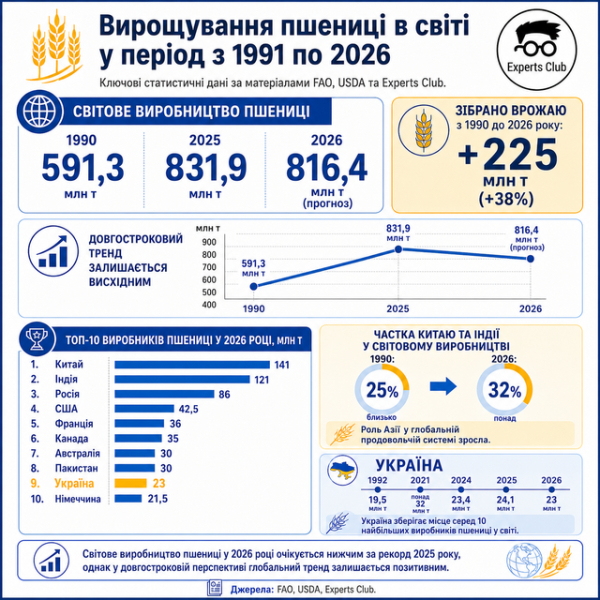
According to the available figures, global wheat production among the countries included in the analysis has expanded from approximately 591.3 million tons in 1990 to an estimated 816.4 million tons by 2026. Consequently, over this 36-year span, production volumes have increased by roughly 225 million tons, or 38%.
The highest output recorded within the dataset occurred in 2025, reaching about 831.9 million tons. The projected figure for 2026 is somewhat lower at 816.4 million tons, which might indicate a slight adjustment following the substantial harvest of the preceding year, yet the overall long-term trajectory remains upward.
While the early 1990s saw the USSR, China, the USA, India, France, and Canada among the leading producers, the current landscape features China, India, the Russian Federation, the USA, France, Canada, Australia, Pakistan, and Ukraine occupying the top positions.
Data from FAO and USDA indicates that in 1990, the USSR produced the largest volume of wheat at approximately 101.9 million tons, followed by China with 98.2 million tons, the USA with 74.3 million tons, India with 49.8 million tons, France with 33.3 million tons, and Canada with 32.1 million tons. The combined share of the top ten producers then accounted for about 77% of the global total.
By 2026, according to available data, China remains the foremost wheat producer with an output of around 141 million tons. India holds the second position with 121 million tons, and Russia is third with 86 million tons. Following them are the USA at 42.5 million tons, France at 36 million tons, Canada at 35 million tons, Australia and Pakistan each contributing 30 million tons, Ukraine with 23 million tons, and Germany with 21.5 million tons.
The share of China and India in global wheat production has significantly grown over this period. In 1990, these two nations accounted for approximately 25% of world production, whereas by 2026, their combined share exceeds 32%. This highlights the increasing importance of Asia in the global food system over the long term.
“Wheat continues to be a fundamental indicator of food security. In recent decades, we have witnessed not only an increase in global production but also a gradual shift in agricultural trọng tâm. China and India have emerged as principal producers, while countries in the Black Sea region have substantially bolstered their influence on the international grain market,” noted Maksym Urakin, founder of the Experts Club analytical center and a Candidate of Economic Sciences.Ukraine plays a distinct role in the current production structure. Based on available data, after Ukraine emerged as a separate statistical entity in the early 1990s, its wheat production stood at approximately 19.5 million tons in 1992.
In 2021, the figure reached over 32 million tons, after which it declined due to the war, logistical constraints, landmines, shifts in cropping patterns, and losses in production capacity. For 2024, wheat production in Ukraine was estimated at approximately 23.4 million tons, projected at 24.1 million tons for 2025, and around 23 million tons for 2026. Despite challenging circumstances, Ukraine remains among the world’s top ten wheat producers and retains strategic importance for the global grain market.
The data also highlights shifts in the US position. In 1990, the United States produced over 74 million tons of wheat, ranking it among the top three producers globally. By 2026, its output is estimated at around 42.5 million tons. This does not signify a loss of overall agricultural potential for the US but rather reflects structural changes in its agriculture, competition from other crops, and alterations in the global production balance.
The Russian Federation, appearing separately in statistics after the collapse of the USSR, has become a key wheat producer in the 21st century. According to available data, its production was estimated at approximately 90.3 million tons in 2025 and 86 million tons in 2026. Concurrently, the former Soviet republics collectively remain a significant hub for global grain production.
“The global wheat market has become considerably more multipolar. Whereas previously a few major producers played the leading role, now several regions are critical for food stability – Asia, North America, Europe, the Black Sea basin, and Australia. Any climatic, logistical, or military-political risks in one of these regions rapidly affect world prices,” Urakin emphasized.The Experts Club points out the importance of distinguishing between absolute production volumes, export potential, and domestic consumption when analyzing wheat. While China and India are the largest producers, a substantial portion of their harvest is utilized domestically. In contrast, Ukraine, the Russian Federation, Canada, Australia, the USA, and France have a significant impact specifically on international wheat trade.Analysts at the center note that the future dynamics of wheat production will be contingent upon several key factors: climatic conditions, access to fertilizers and seeds, energy costs, the state of logistical infrastructure, trade restrictions, wartime risks, and government policies supporting the agricultural sector.The Experts Club estimates that a long-term visualization of wheat cultivation figures allows for a better understanding of how the global food system has evolved since 1990, which countries have strengthened their positions, and why grain production remains a critical element of economic and political security.